Most people buy flowers the way they buy a bottle of wine for a dinner party: something in season, something that looks well on the table, decision made in four minutes. That works. But a small shift in how you choose them turns a pleasant gesture into one that lands. Learn a dozen floral meanings and you gain a way to say I noticed, or I'm sorry, or no hard feelings without writing a paragraph about it.
The mistake is treating flower language as a cipher, where each stem has one correct translation and getting it wrong is a disaster. It isn't. Think of it as vocabulary. You choose a few words you know, arrange them in a sensible order, and let the note carry the rest.
Why the Meanings Are Looser Than You Think
The system most of us half-remember comes from nineteenth-century floriography, when publishers turned out dictionaries assigning a sentiment to nearly every bloom. Those dictionaries did not agree with each other. Rosemary signified remembrance at a funeral and remembrance at a wedding, which sounds contradictory until you notice it means the same thing in both rooms. Basil was good wishes in one volume and loathing in another. Marigolds stood for grief in some traditions and passion in others.
That looseness is useful rather than annoying. It means you can choose meanings that fit your own life and your own region, as long as you stay consistent within a single bouquet and don't rely on the flower to explain itself entirely.
Two rules keep you out of trouble. First, let one flower carry the message and the others support it; a bunch where every stem shouts a different sentiment reads as noise. Second, say the meaning out loud in the note. Flower language works best as a wink, not a test.
A Starter Vocabulary You Can Actually Use
These are widely repeated traditional meanings, not rules. Where traditions conflict, I've said so. Pick the version that suits the person receiving the flowers.
- Rosemary: remembrance. Works for congratulations and condolence alike, which is rarer than it sounds.
- Ivy: fidelity and attachment. A generous trailing vine makes a small bunch look intentional.
- Myrtle: love and commitment, long used in wedding flowers.
- Forget-me-not: exactly what it says. Small, blue, easy to tuck in.
- Sweet pea: delicate pleasure, and sometimes goodbye. Read the room.
- Lisianthus: appreciation and gratitude. It looks like a rose that has read a few books.
- Ranunculus: "I'm dazzled by you." Reliable in cool weather, hopeless in a heatwave.
- Zinnia: friendship that lasts. Cheap, cheerful, and everywhere from midsummer.
- Aster: patience, and in some traditions a late-blooming kind of love.
- Freesia: friendship and innocence, with a scent that fills a hallway.
- Hyacinth: constancy. The forced bulbs in January are the ones to buy.
- Carnation: pink for gratitude, red for admiration, white for remembrance, striped for refusal. The Victorians were specific about carnations.
Colour Does a Second Pass
White reads as a beginning or a farewell, depending on the room. Red is the least ambiguous colour in the language and the easiest to overdo. Pink softens almost any message. Yellow splits opinion: friendship in many modern florists' hands, jealousy in older dictionaries. If you're sending yellow roses to a partner, send a note that makes your meaning plain. Green material, the part most people forget, is not neutral either: eucalyptus suggests space and calm, ivy suggests closeness. Choose accordingly.
How to Read the Bouquet Already in Front of You
Before you build anything, practise on what you've been given or bought on impulse. A bouquet has a grammar. Find the flower that appears most often, or the largest one; that is the subject of the sentence. The smaller blooms clustered around it are modifiers. The greens are punctuation, setting pace and holding the thing together. Then look for the stem that doesn't quite belong, the one odd colour or the sprig of something fragrant tucked at the back. That is usually the part someone chose deliberately.
Ask three questions of any arrangement: what is it celebrating, who is it for, and what would I have written on a card? If the answers don't match the flowers, the flowers are decoration rather than language. That's fine too. Not every bunch needs to mean something.
Three Everyday Situations, Decoded
For a friend who has had a hard fortnight
Skip the grand sympathy bouquet, which can feel heavy. Three stems of lisianthus for gratitude, a few sprigs of rosemary, and something green and soft, in a small jar. Nothing towering, which is too formal for a kitchen table, and nothing heavily scented if they've been unwell.
For a neighbour who took in your parcels four times
One colour, done well. A tight bunch of pink carnations, or a single hyacinth in a small glass. This is a note-sized gesture, and oversized flowers will embarrass everyone involved.
For an apology that has to be small
White and green only: white ranunculus, ivy, a little eucalyptus. Nothing red, nothing variegated, nothing that asks for a reaction. Keep the card to two sentences and leave the jar on the doorstep.
Building It: A Method You Can Repeat
- Choose one message. Not two. Gratitude, or congratulations, or sorry. Decide before you go shopping.
- Pick a main flower and buy an odd number of stems. Three or five of the same bloom is easier to arrange than four, and looks less like a supermarket bundle.
- Add one supporting flower in a neighbouring colour. If the main flower is apricot, the second could be cream or soft peach. Not purple.
- Choose two greens. One upright, one trailing. Rosemary and ivy will do for almost everything.
- Cut the stems at an angle under running water and strip any leaves that would sit below the waterline, where they rot.
- Use a vase with a narrow neck. It holds a small bunch upright without fiddling, which matters when you're arranging three stems on a Tuesday.
- Change the water every second day and re-cut the ends. This single habit does more for vase life than anything you add to the water.
Let the Note Do Half the Work
The card is not cheating. It's the point where the flowers stop being a mood and become a message. Three lines is plenty: name what the flowers mean, say why you chose them, then stop. "The rosemary is for remembering, the lisianthus for thanks. I hope this week is kinder than the last one." That's a paragraph of feeling in two sentences, and the flowers carry the rest.
If you're giving flowers to someone with pets or small children, check before you bring anything home that might be nibbled, and keep anything questionable out of reach. Two minutes of searching the specific flower is worth it.
Start with one meaning you like and use it until it becomes yours. After a while you'll have six or seven flowers you reach for without thinking, and a small gesture that says something quite specific to the person holding the jar.
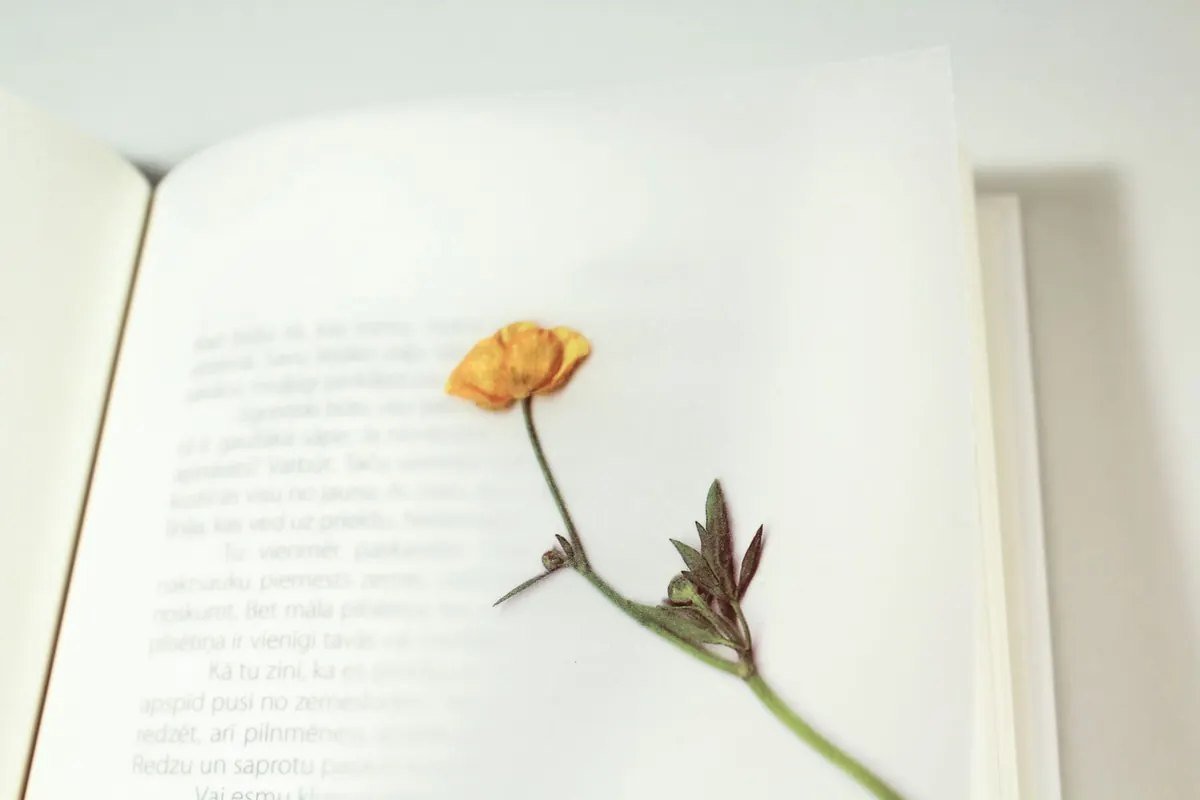
Photo: Elīna Arāja / Pexels